

Methylene Blue & Red IV Laser Light Therapy: A Photodynamic Power Duo

magic blue

What Is It?

This therapy merges two key elements:

  • Methylene Blue (MB): A synthetic dye that becomes highly reactive when exposed to red light. It concentrates in areas of inflammation, infection, and mitochondrial dysfunction.

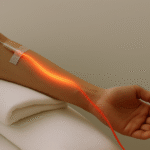
  • Red IV Laser Light: Delivered via a fiber-optic line placed into a vein (similar to an IV), this light therapy emits a precise 660 nm wavelength—ideal for activating Methylene Blue in the bloodstream.

When combined, they trigger photodynamic activity that can modulate the immune system, reduce pathogens, and energize the body from within.

How It Works

  1. Step 1: Methylene Blue Ingestion

    • A liposomal form of MB is taken orally, usually 2 hours before the IV laser.

    • If other IVs (like ozone) are scheduled first, time the MB so that red light is administered 2–3 hours later.

  2. Step 2: IV Red Laser Activation

    • A sterile fiber-optic catheter is inserted into a vein.

    • 660 nm red light flows through the bloodstream, activating the MB wherever it has concentrated.

  3. Step 3: Cellular Response

    • Activation generates singlet oxygen and ROS (reactive oxygen species).

    • These agents selectively target infected, inflamed, or dysfunctional cells.

    • Mitochondria may receive a temporary boost, enhancing energy production.

    • Blood flow and oxygenation often improve—a benefit known as enhanced rheology.

Wavelength Color Function
660 nm Red Activates Methylene Blue efficiently and safely

What Conditions Might Benefit?

✅ Bioregulatory & Integrative Clinics

  • Chronic infections: Lyme disease, EBV, mold illness

  • Chronic fatigue and fibromyalgia

  • Immune dysregulation


✅ Longevity & Biohacking

  • Mitochondrial support

  • Synergy with NAD+, CoQ10, or ketones

  • Enhancing metabolism and cognitive clarity

✅ Post-Viral & Recovery Protocols

  • Long-haul viral symptoms

  • Immune rebalancing

  • Cellular detox and oxygenation


Why Methylene Blue?

Methylene Blue isn’t just a dye—it’s a molecule with a mission:

  • Selective uptake: Accumulates in stressed, infected, or energy-depleted cells

  • Low-light activation: Easily activated with red light—no heat or damage

  • Dual roles: Works as both a redox balancer and ROS generator

  • Safe profile: Generally well-tolerated at therapeutic dosages

Methylene Blue + IV Red Light therapy is more than just high-tech wellness—it’s mitochondrial medicine in action. With roots in science and results showing promise in energy restoration, immune modulation, and pathogen targeting, it’s no wonder this therapy is gaining traction in integrative settings.

Whether you’re recovering from chronic illness or just looking for a next-level mitochondrial tune-up, this dynamic duo might be worth exploring.

Ready to start your journey to better health?

Dr. Sorina Simion-Rodgers

Dr. Sorina Simion-Rodgers

Related Posts

rigvir
January 9, 2026
What Is the Rigvir Virus?

After injection, the Rigvir virus replicates inside tumor cells and destroys them (oncolysis). When tumor cells rupture, Rigvir is released and spreads to nearby tumor cells.

FDA hormone therapy
January 9, 2026
FDA finally removes the black-box warning for hormone replacement therapy

For more than 20 years, menopausal hormone therapy (MHT) has carried a boxed warning about cardiovascular disease, breast cancer, dementia, and other serious health risks. This warning was based largely on findings from the Women’s Health Initiative (WHI) trial—specifically the arm studying oral conjugated equine estrogens (CEE) combined with medroxyprogesterone acetate (MPA). It is critical to clarify what the WHI actually studied. The estrogen used was equine-derived, not human or bioidentical estradiol, and it was administered orally, combined with a synthetic progestin (MPA). Despite these very specific exposures, the concerning findings from this single formulation and route of administration were rapidly expanded by the FDA—without direct clinical evidence—to include all estrogen-containing hormone therapies, regardless of hormone type, dose, formulation, or route of administration. The Problem With a One-Size-Fits-All Black Box The boxed warning treats all hormone therapy products as if they pose identical risks. This includes local, nonsystemic therapies, such as low-dose vaginal estrogen, which have minimal systemic absorption. It also assumes that all women carry the same level of risk when using hormone therapy. This approach does not support individualized care. In fact, it actively undermines it. The black box warning is often the first—and sometimes only—thing patients see. Its stark language creates fear and confusion, making it difficult for clinicians to explain meaningful differences between hormone formulations, routes of administration, timing of initiation, and individual risk profiles. Rather than facilitating shared decision-making, the warning becomes a barrier to it. The consequences have been profound. Since the early 2000s, hormone therapy use has declined by an estimated 70%–80%, even among women who …

brain
January 3, 2026
Depo-Provera and Meningioma Risk: FDA Label Update and What It Means for Long-Term Health

In December 2025, the U.S. Food and Drug Administration (FDA) approved a label update for the long-acting injectable contraceptive depot medroxyprogesterone acetate, commonly known as Depo-Provera. The updated label warns of a potential increased risk of meningioma, a type of tumor affecting the protective lining of the brain. This update reflects emerging scientific evidence and underscores the importance of informed, individualized decision-making when considering long-term hormonal therapies. What Is a Meningioma? A meningioma is a tumor that develops in the meninges, the membranes surrounding the brain and spinal cord. While many meningiomas are benign, they can still cause symptoms such as headaches, vision changes, seizures, or cognitive effects depending on size and location. From a longevity and brain-health perspective, even benign tumors are clinically relevant due to their potential impact on neurological function and quality of life over time. What Does the Research Show? The FDA’s label change was prompted by findings from large population-based studies evaluating hormonal contraceptive exposure: Although these studies are observational and do not establish causation, the consistency of findings across large datasets led regulators to update product labeling. Which Depo-Provera Products Are Affected? The updated FDA warning applies to both formulations manufactured by Pfizer: An Integrative and Longevity-Focused Perspective At Bionuu, we view hormone therapies through a systems-based lens. Hormones influence not only reproductive health, but also: This FDA update highlights a key integrative principle: the timing, duration, and cumulative exposure to hormones matter. While Depo-Provera remains an effective option for some individuals, long-term use—particularly later in reproductive life—should be periodically reassessed. …

bloodflow
November 4, 2025
Why Thermal Dose Matters in Hyperthermia Therapy

When it comes to therapeutic hyperthermia, one principle rises above all others: Thermal dose matters. This simple but powerful truth is at the heart of every successful hyperthermia treatment. The temperature you reach—and how long it’s maintained—directly determines whether a treatment is biologically effective. The Science Behind Thermal Doseage Hyperthermia works by safely heating tumors to temperatures that stress and sensitize cancer cells while supporting healthy tissue recovery. But not all heat is created equal. Clinical studies have shown that the precise thermal dose—the amount of energy absorbed by the tissue over time—has a direct, measurable effect on outcomes. Two landmark studies in cervical cancer patients highlight this relationship clearly: Franckena et al., 2009 (420 patients): Higher thermal dose parameters (CEM43T90, TRISE) were powerful predictors of tumor response, local control, and overall survival. Kroesen et al., 2019 (227 patients): Even with modern radiotherapy, patients who received a higher thermal dose achieved better local control and improved outcomes. These studies confirm that accurate, reproducible thermal dosing is essential. Without it, hyperthermia cannot reach its full therapeutic potential. Thermofield: Engineered for Precise, Reliable Thermal Dosing When lives are on the line, reproducibility is not optional. That’s why Thermofield was designed by electrical engineers—to ensure every treatment delivers a clinically meaningful and verifiable thermal dose. Here’s how Thermofield ensures safety, consistency, and precision in every session: Consistent Thermal Dose — Not Guesswork Safer, More Even Tumor Heating Energy Directed Where It Matters Confidence in Every Session Aerospace-Level Engineering Independently Tested and Certified Validated …

July 18, 2025
What Is IV Photodynamic Therapy (PDT) with Photosensitizers?

Harnessing Light for Cellular Healing
Intravenous Photodynamic Therapy (IV PDT) is a leading-edge treatment that uses light-sensitive compounds activated by specific wavelengths of laser light delivered directly into the bloodstream. At Bionuu, we use the Weber EndoLaser system to target inflammation, infections, and abnormal cells at the mitochondrial level. This therapy supports immune function, improves oxygen utilization, and helps disrupt pathogens and damaged tissue—offering a powerful, non-toxic tool in integrative care.